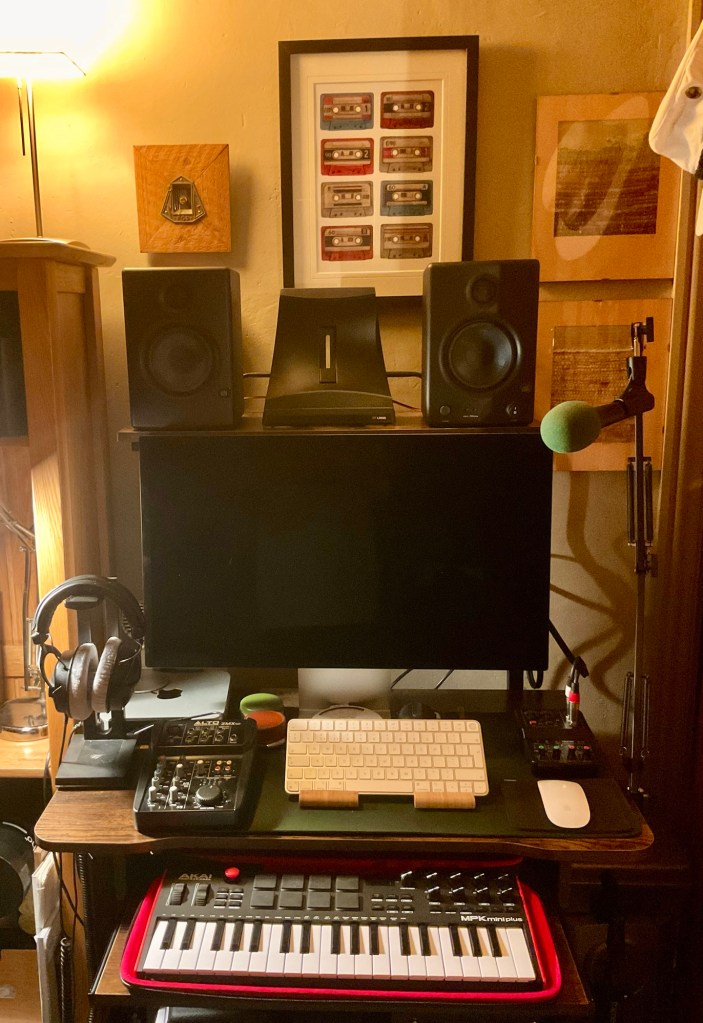
Mixing and recording equipment……current status.
I bought an Audio Interface off Amazon. (below image and right side below in my taken photograph) It goes directly into the Apple Mac mini M2 Pro USB port. All the recordings you hear of mine (on this GarageBand/Apple Mac mini M2 Pro combination) concerns the electric guitars plugged directly into the interface with a 1/4 inch jack lead. The acoustic guitar is played through a microphone which is also plugged directly in to the audio interface. Microphones are either condenser or dynamic. And are each connected with their own different types of plugs. XLR, 1/4 inch jack plugs, USB-C or USB. A USB standard connector lead to computers came with this audio interface. Doesn’t use mains to drive it, so no mains plug. Plug the USB into the Mac M2 and it’s ready and good to go.
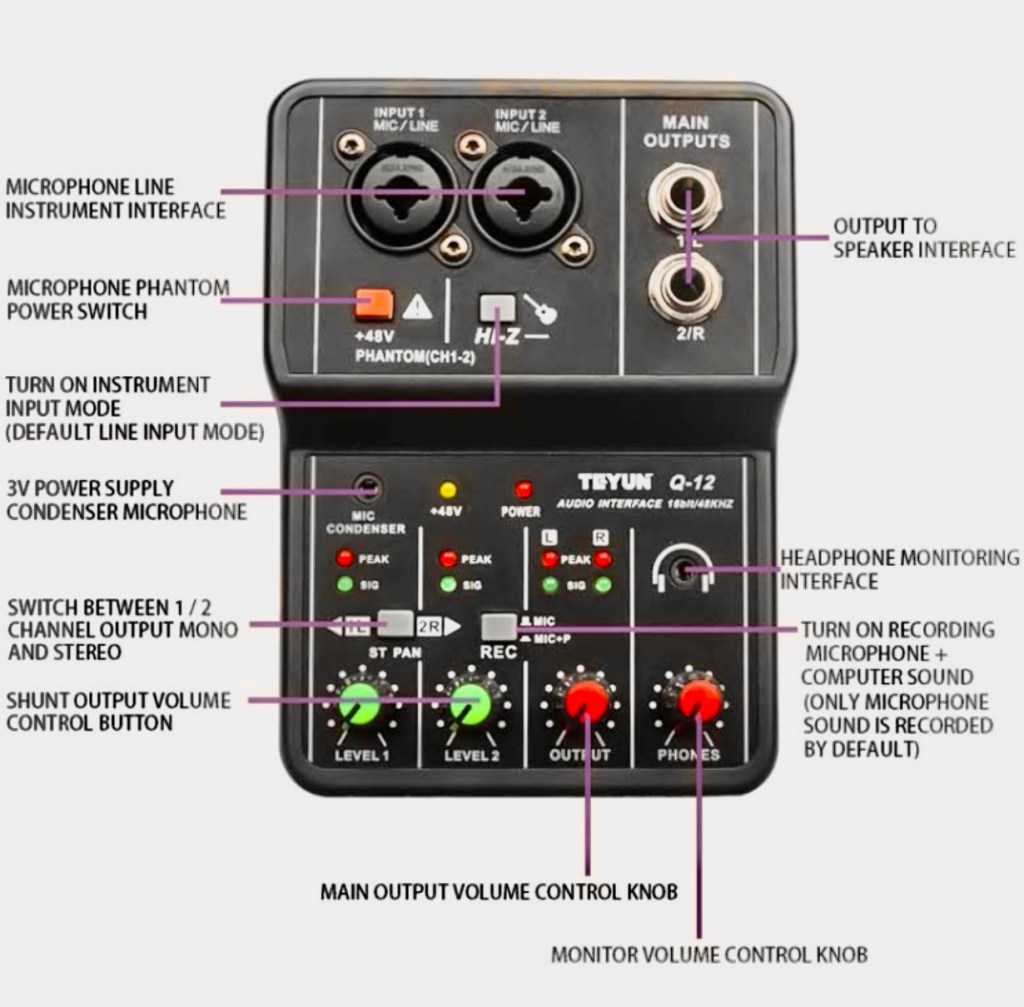
MY TWO UNITS BELOW. BOTH BOUGHT BECAUSE THEY WERE CHEAP OPTIONS.

Bought the mixer ‘desk’ (left side above) from a charity shop extremely cheaply. A £10 note. I then bought a couple of different 1/8 and 1/4 inch male/female jack connection leads to link the mixer to the audio interface which gives me options for different port connection choices. I want to connect the mixer into the audio interface to experimentally mix externally on it. This is opposed to mixing within the GarageBand system. It may give a better EQ sound for the guitars and voice.
The mixer is mains 3 pin plug driven.
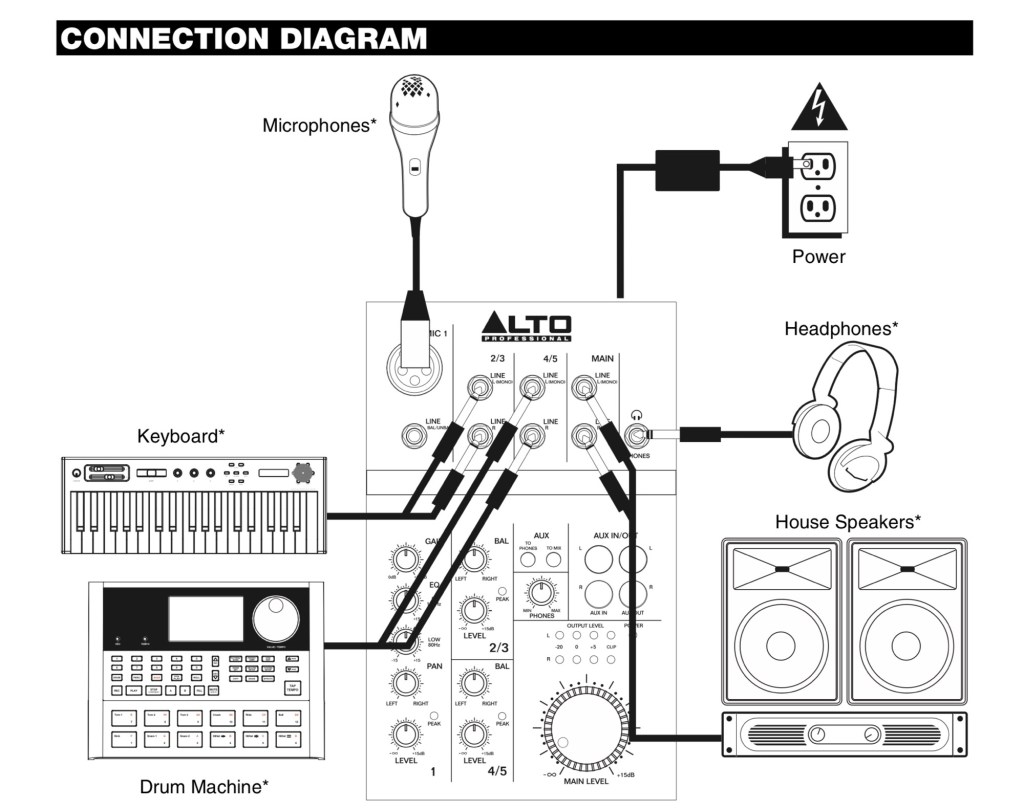
You can plug your keyboards, drum pads, etc. into the mixer, which is, as said, connected to the audio interface, which is then connected to Mac M2 and then record into the GarageBand programme. The monitor is an Apple Studio Display.

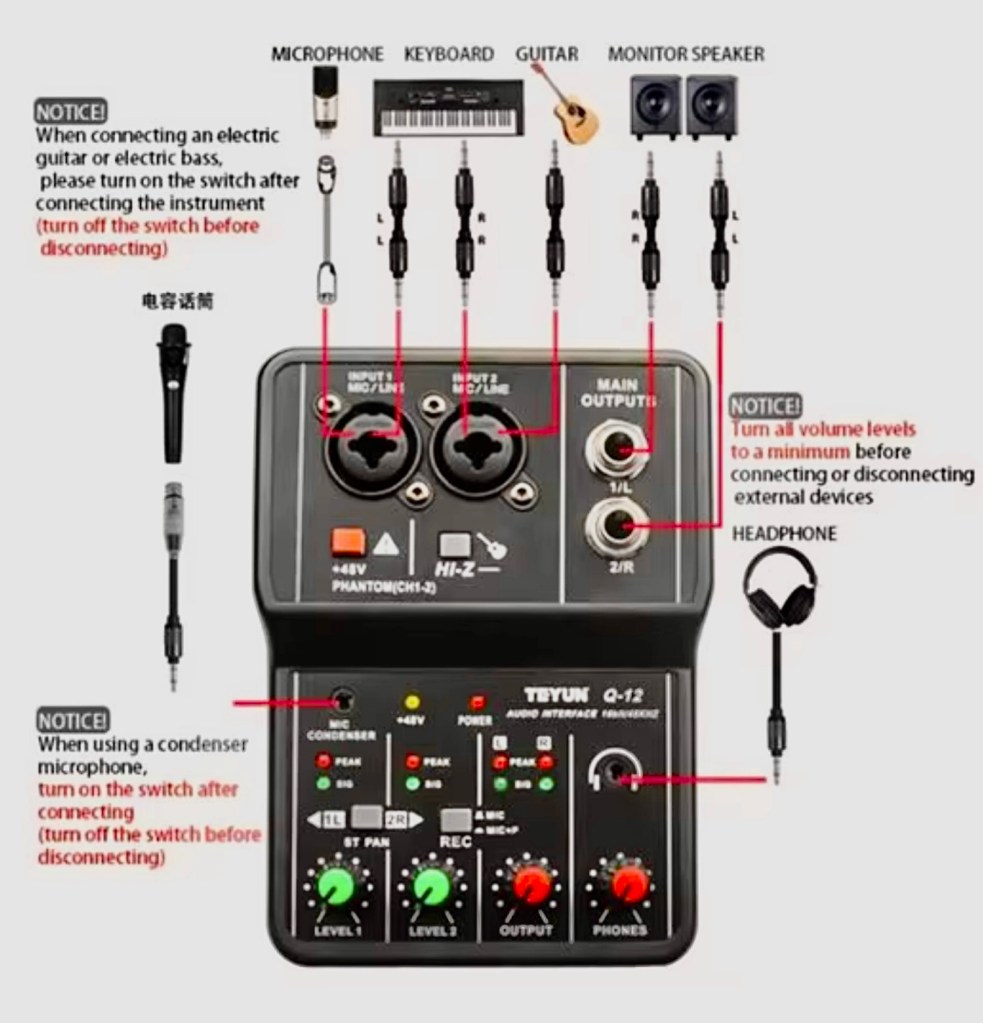
Listening back to what you have recorded is either through monitor speakers or headphones choice.
Headphones do not produce external noise. So when you are recording individual instruments or vocals through microphones, you don’t want interference from the speakers’ external noise. It is bad enough with ambient household and external sounds from passing cars or overhead jets! There is a background subliminally heard telephone ringing on one of my songs. Near the end of the last song below. I wonder if you heard it! It may not be there. I may hear it now forever. I always, and will forever, hear my Mum shouting my name on one of Marc Bolan’s T. Rex tracks. Probably wanted me to turn down the volume.
I now have the choice that I can play bass, electric guitars and microphone choice for acoustic guitar/vocals into either the audio interface or the mixer for recording separate tracks and layering the songs in GarageBand. The mixer, as said, will allow me to create EQ on its own dials and buttons.

The AKAI Professional MPK Mini Plus, with 37 keys, is a USB MIDI Keyboard Controller. This directly accesses the GarageBand library for options to play thousands of instruments choices. It is a very complicated unit with amazing capabilities if you want to use it seriously.

So……recording is a very technical ongoing process. You could get really carried away. I suppose it is a balance of keeping your feet on the ground technically against flying with the euphoria of writing your songs.
Headphone use:
For recording mainly. You can listen back to individual tracks within the overall sound once recorded. Or the whole sound of collective instruments played against each other. It’s a weird vibe. A little headphone icon on each track can be switched on or off. So, out of 8 separately recorded instruments/vocals for example, you can listen to 2, 3 or 4 together by switching the headphone icon off on the others. A mix of sounds heard and their compatibility. I often play and record the guitar part against just drums and the bass guitar line. The keyboard inclusions I played, like synthesiser, brass, woodwind, piano parts from using the Akai keyboard, are switched off and silenced.
Monitor/Speaker use:
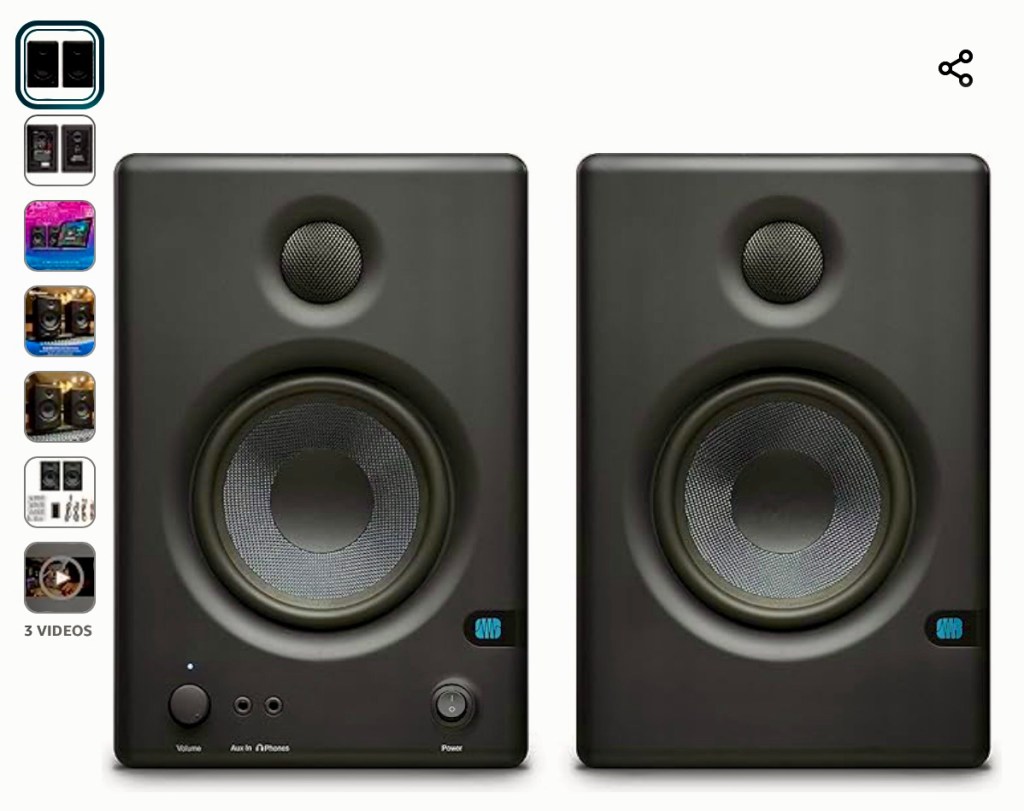
PreSonus Eris E4.5, Studio Monitor Speakers, Pair, 4.5 Inch, 2-Way, High-Definition Multimedia from Amazon.
Just bought these the other day for mixing the song sound. They are monitors and not truly speakers in the sense of listening to your albums, CD’s, etc. through. They are targeted for mixing music.
I can’t even begin to think what the results will be once I attempt this process. I do know you have to get the song sounding decent enough to then go on and mix its instrumental layers in creating a listenable experience. First steps will be enlightening. Later down the line is to avoid disheartening. Summers’ Skills? A pig’s ear disaster or a Tony Visconti/George Martin beautiful success. On the scale of the former being a 0 and the latter being a 100……I’d be happy with an initial 20 to 25 outcome. Then go on to capture a decent presentation of what Frail Autumn are all about. You can always improve if people give you their feedback as to good and bad.
In a Summarise Summers way. The Apple Equipment was expensive for myself and was deliberated on carefully. Whether to go with it. My wife really did encourage me as she knew the band live idea was a non starter after the other guys were realistically committed to their busy lives and couldn’t commit. I was left up S**t’s Creek without a paddle emotionally. The rest of the equipment has been a really focused ‘what is the best buys possible to avoid expense’ exercise. Lucky finds on eBay auctions or charity shops really. Even the guitars have been secondhand fairly cheap finds after my Fender Jazz Bass and amplifier expense. Home recording can get away with you monetarily and be very expensive as a hobby. Care has to be taken to come to a point where you are ready to go confidently and allow what you have to be used to its fullest capabilities. More expensive equipment isn’t going to improve what I now have, because I wouldn’t have the skills to use it anyway.
Anyways. This blog is just to give you the overall picture from where I am currently.
EXAMPLES BELOW:
Recording over three time frame stages. From the very first attempt to record, the second ‘getting used to the system a bit more confidently’ to the latest, ‘Nice……but I still have an awfully long way to go’, song.
 Gray Summers
I like all of these very much. they’re all super recordings. I wish I had a technological head. it’s really cool that you’re committed to discovering more and more about this part of making music.
LikeLiked by 2 people
Cheers cookie. I wish I had a decent musical ear for assessing differentiation within the sound. Too much loud music over the decades has damaged the cochlea auditory sensory hair like cells and the frequencies aren’t brilliant anymore.
Like you yourself feel about your skills, I don’t actually possess a technical head. I keep forgetting what is what and what is compatible with each other. And no visual memory to reflect and remember what I have seen before on the system. Rote learning is a slow process. But all together, it is a valuable pursuit because it involves others to join in to the project in the future. And if I feel there is some knowledge to offer and present some skills, then it will help my confidence.
Despite your qualms regarding your technophobe mind cookie….you create great sound to your music. Very listenable, very hauntingly wonderful and ultimately unique. All the best.
LikeLiked by 2 people
We have sooo been there, Gray, regarding our others who “…busy lives and couldn’t commit. I was left up S**t’s Creek without a paddle emotionally.” And this was a big reason we were open to moving to a northern state. But people, we find, are busy—everywhere. Ugh
Oh, I forwarded this excellent information (your whole post), to Richard, so he could see your setup. Yes, we all spend a lot of funds on these things, Gray. But we don’t golf or gamble, so there’s that. Cheers!
LikeLiked by 1 person
Rural living has massively changed the previous music journey scenario from the 1970/80s. Distance from the familiar musicians, who could get involved, is massive in miles now. Local people have their own set ups and dynamics and, despite the slower pace locally, are active and therefore too busy gigging or involved with their own projects. And of course there are far fewer people to contact than in a busy town. So….flying solo continues. Cheers Sheila.
LikeLiked by 1 person