
Sorry! Another long blog on pens. Last one though. Going back to recording music next week. The sun has begun to shine again here in Wales, UK, where a fair few months of very damp and rainy weather has been evident. So seems appropriate.
A book suggestion by my daughter. ‘You will love this’ she says. So I took down the title and ordered it. Reading the first chapter and on pages 22 to 23 I stop in my tracks. I smiled at the recognition of why I use, and have always used, fountain pens.
It reads…
‘It’s my first time using a fountain pen, so I’m not sure what to say, but it’s refreshing somehow. It doesn’t take much pressure to change the force, and I don’t really know how to explain it, but I feel that it makes my handwriting better’.
Takarada-san nodded a number of times, looking happy as if he himself were being complimented. ‘Unlike pencils and ballpoint pens, which need to be pressed against the paper to write, fountain pens employ capillary action, so as long as the nib is touching the paper, it will write. A larger contact surface area will give you thicker, broader strokes, while a smaller contact surface area will yield slimmer, weaker lines – the writer can make these subtle adjustments at will. In other words, a fountain pen is similar to a brush dipped in ink’.
Taken from ‘Letters from Ginza Shihodo Stationery Shop’ by Kenji Ueda.
Takarada-san is spot on!
Reading from that first chapter, it started a train of thought. Back in the 1960s, my secondary grammar school had a rule. Use fountain pens only and not ballpoints. My purchase back then was a beautiful burgundy coloured Osmiroid #65 with a fine tipped italic nib. My teenage years were essentially….that pen. After leaving school, fountain pens were, and have always been, my first choice in life. I remember being given a few fountain pens for my 18th birthday. My wife bought me a wonderful Parker 75 and a couple of friends bought other choices. My wife’s gift of the Parker was used for years on years until the section that holds the nib developed a split and ink leaked everywhere. The others from friends have long gone and it’s difficult to recall the makes. I think they were Parker’s too. But longevity was not their forte. Rather akin to my worn down memory.
It was a case of writing with stainless steel nibs initially back then. But, on collecting secondhand vintage pens around a decade ago, (as seen in the pot photograph above) 14 carat gold nibs on vintage pens are what I find the most fascinating. Their quirkiness and unpredictability is lovely.

The ease of a fountain pen and writing ink onto paper is a pleasure. A once in a lifetime find, as to a particular fountain pen that suits you in totality, is akin to being given an extraordinary ‘here for life’ gift. And, once mastered, is so much easier as a pen friendly experience than using a ballpoint. It doesn’t write the word choices for you though does it. Doesn’t provide less enquiry! The lettering may be imaginative or quirky. But imagination and quirky thought still belongs to the author/writer. One’s own thoughts, reflections, ideas and contribution to the blank sheet of paper in front of you is still a committed exercise to get involved. Process and progress of a gentle, therapeutic nature. Addressing the senses. The varied smell of individual inks, the sound of a nib scratching pleasantly on the paper surface, the sight of words forming and finding their unique balance, the touching of the whole synergy of surroundings as to what is involved in the art of writing. And the taste of coffee, Jack Daniels or deep, rich spicy red wine whilst scrawling out your inner thoughts. Thought I would throw that last ‘taste’ one in. Ink doesn’t taste that great. And I never chew on a fountain pen barrel end either.
When words are written out in long hand, thoughts are very much more measured before writing them down. Ease of writing out those thoughts, and instrument choice, is certainly an ergonomic decision to be deeply thought out. Whether a long essay or even a few lines of affirmations or sage like sayings. I was exchanging comments from a fellow blogger the other day (Brenda from Curiosities, Castles and Coffee Shops: the musings of a curious mind) and we spoke of this ‘which is best…writing on paper or typing onto a screen as a choice for achieving the best dynamics in recording reflective thoughts’. She used the word ‘measured’. And I actually agree. That wonderful act of holding the moments with deep thoughts, nods, agreements with one’s inner choice of ‘I can continue now’ and the whole act of presenting the pen to paper again returns to that very sublime writing synergy experience. It is as if you have won the battle in successfully choosing the correct way to continue from your deliberations and are rewarding yourself with a further example of commitment to your choice of pen and paper. Weird isn’t it.
I love fountain pens primarily. But am not averse to other choices. I have taken a ballpoint on overseas holidays in the past, because I was wary of a fountain pen leaking in high altitudes on a plane flight. I have other general choices re: gel, art and rollerball pens too. Mainly because some of the paper choices I have used are not fountain pen friendly. The words ghost onto the other side of the paper, which makes writing newly onto that other side irksome. It is like invading each sides’ space. Crashing the vibe and clean nature of the page filled stories told. Worse is when the inks feather/spider out due to the paper’s porosity. Ink travels along the paper’s fibres and a well formed letter or word structure written nicely is ruined. So, as to not waste the paper, a rollerball or gel pen is often used. I buy the pens that can take refill replacements (similar to a Parker biro refill in changing rollerball and gel pens with refills). Or micro pens that can take ink pigments by screw removing the pen barrel end and syringing inks inside to refill.
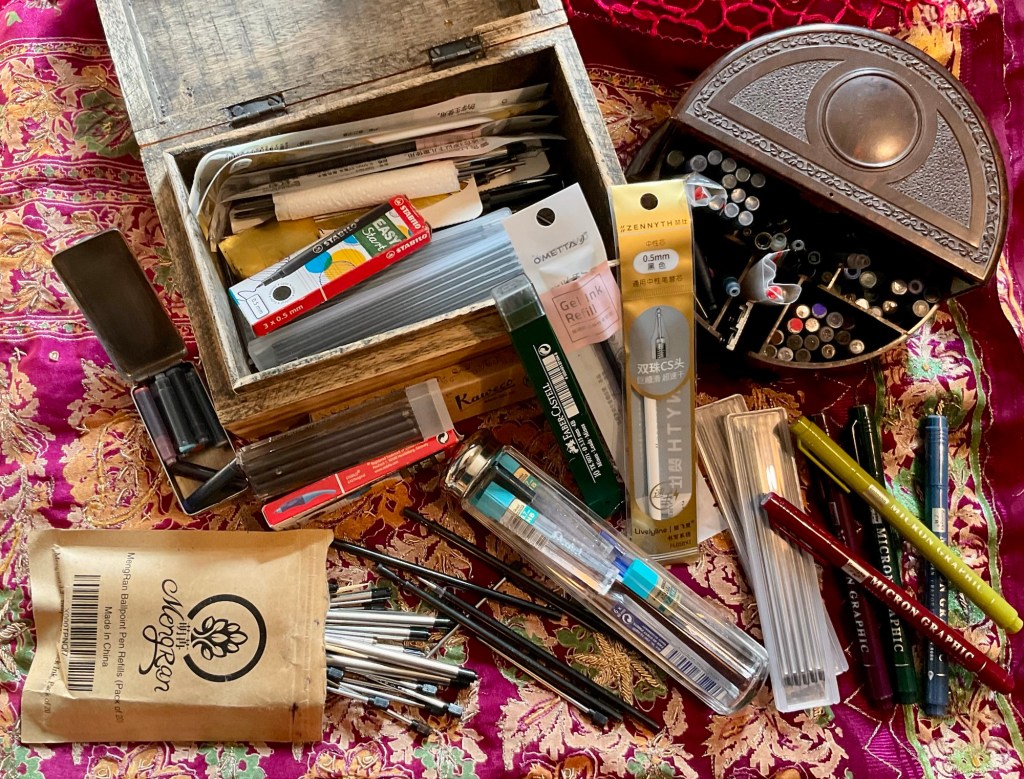
Talking of refilling, a fountain pen needs bottles of ink or cartridges. This, to my way of ethical thought, is very much a nice principle to follow re: avoiding waste. Especially plastic waste. My wife uses a pen or pencil all day long at work. And uses them a lot! So I have bought many different refill considerations. She has been given many different pens from company representatives that, due to her having a Wholefood Shop with ethical and organic considerations, are very nice ones. Some of the pens given are sublime. Bamboo, recycled plastics, hard cardboard, etc. Click or twist mechanisms to introduce the biro end. When the need for a refill arrives, it is surprising how many have different sized choices. Rather like fountain pen cartridges. Universal options of a generic nature exist, but do not fit certain makes. If I have the need for a Sheaffer, Parker or other makers’ unique cartridge to be changed…I have tiny cartridge sized needle and syringes. So, I can keep the empty cartridge and refill them from bottled ink. As said…I like avoiding waste. Hence, it is a case of getting a variety of numerous refills for keeping the pens owned in both my wife’s shop and ones that I own. I keep a variety of refills in a box here at home (see below).
So. When my wife has grown fond of particular pens from work that suit her ergonomically, she asks, ‘Have you got a refill for this one?’ ‘I have’, I say with a smile. And so the pen returns to start over again. And again and again. Mechanical pencils are her choice too. But, she does actually love the two Blackwing pencils (602 and Natural) I gave her to try! Oops! Bad move on my part!
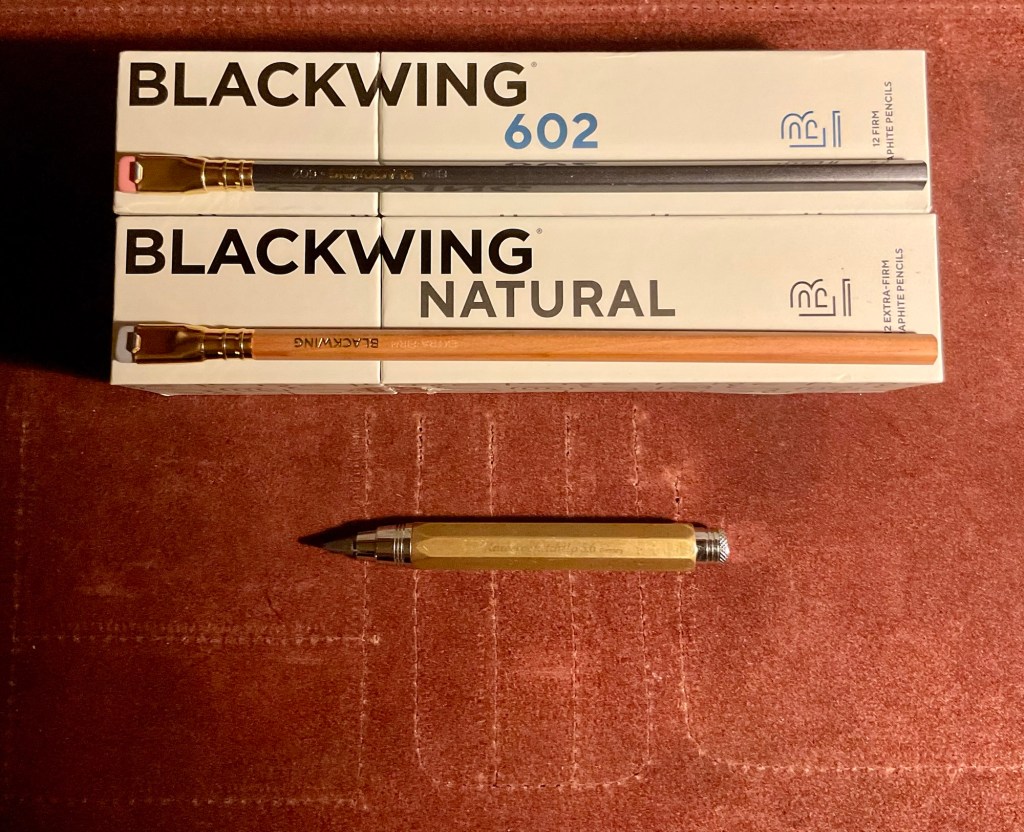
I have been considering using a pencil for writing long hand for a very long time now. I do have lots of pencils, pencil crayons and wax crayons in boxes. Great for the grandchildren to dive into and draw and write to their hearts’ content. For myself, I have recently splashed out and bought a couple of the Blackwing pencil choices. The 602 firm graphite and the Natural extra firm graphite lead inclusions. Two boxes with a dozen in each. My gosh….they cost! Ergonomically? Interestingly, on the 602 it reads ‘Half the pressure. Twice the speed’. So, they are concerned with the ease and comfort in using their pencils too. I have heard that Blackwing have designed a roller ball pen now. I daren’t look at the price!
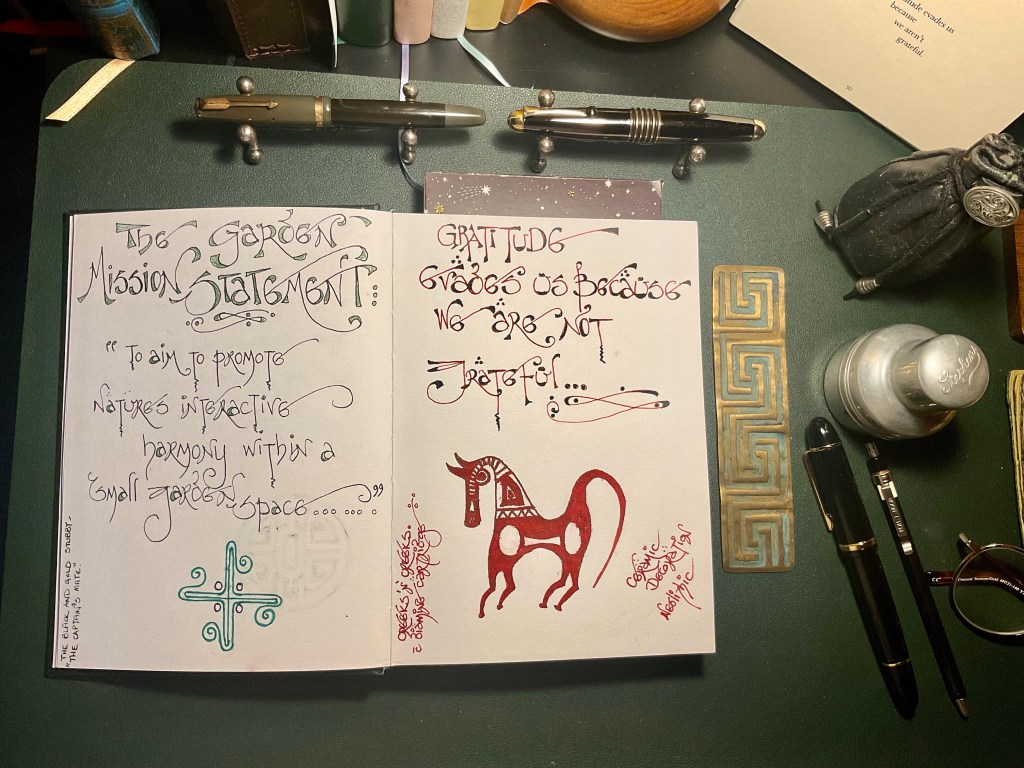
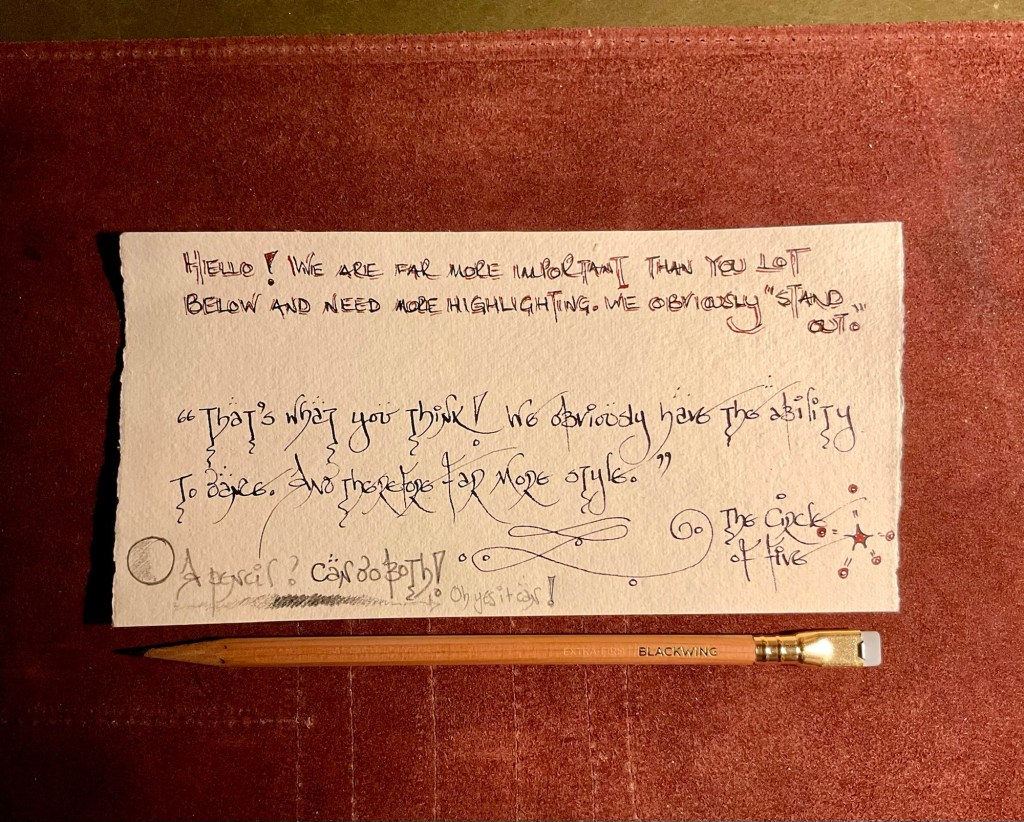
When using a pencil, I like to doodle little pictures with it. But recently, I am keen to write in my two ‘Meditation Sessions’ journals using one. I have a list of what is included in the setting up of a session. What equipment, visual/aural aids and which meditation style adopted. This to reflect for how synergy of inclusions work. And the second journal is the actual reflective recording on each session. I used the two book journals, and not just one, because the B6 sized journal leather cover I made houses two books far more comfortably. Snug as two bugs in a rug so to speak. A case of Before (Set Up) and After (Reflection) will be a nice experience I suppose. Why use a pencil though? Simplicity really. They can glide with thoughtful pressure. And provide deeper lines for important highlights with adding more pressure when writing. Because I use a fountain pen, the writing experience is always one of light touch of nib on to paper. But I have to go over letters twice to add heavy emphasis to lettering or add a different colour around each letter in order to let words and sentences bring more ‘Hey! We are important bits of information and need to be noticed’ type scenarios on the paper.
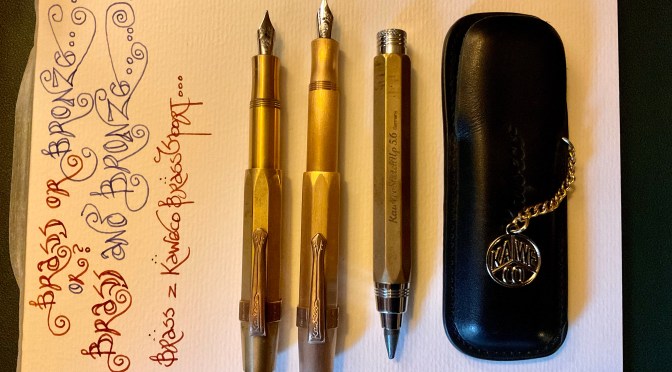
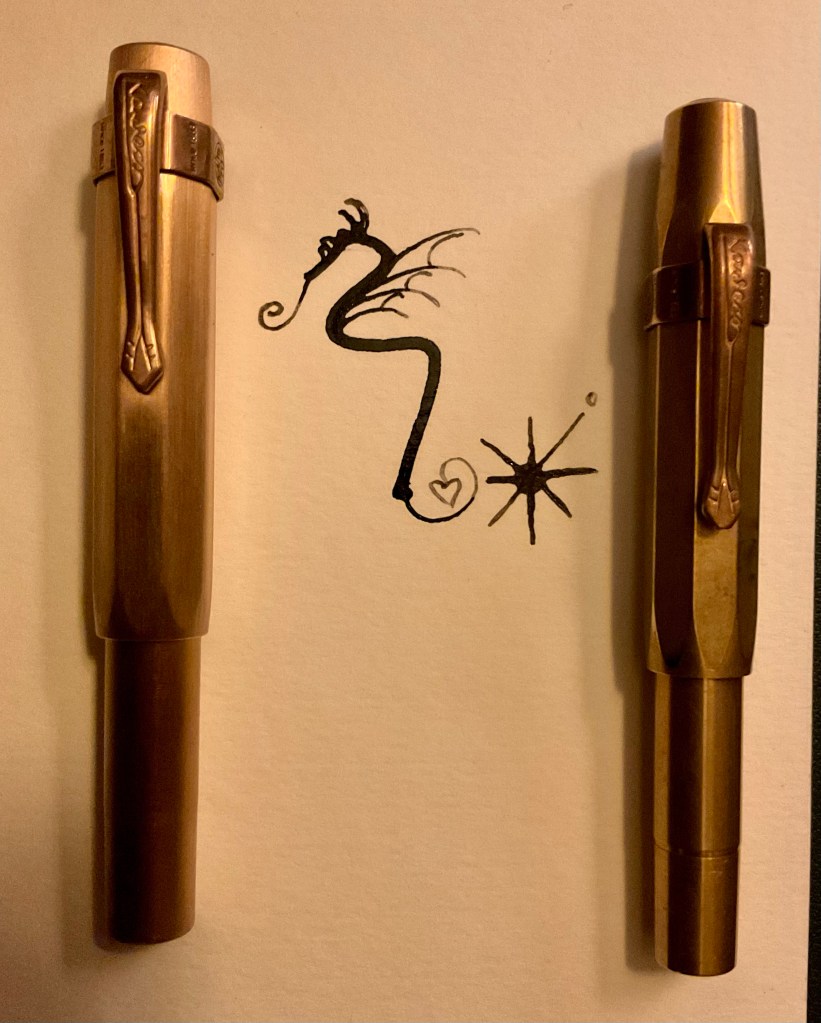
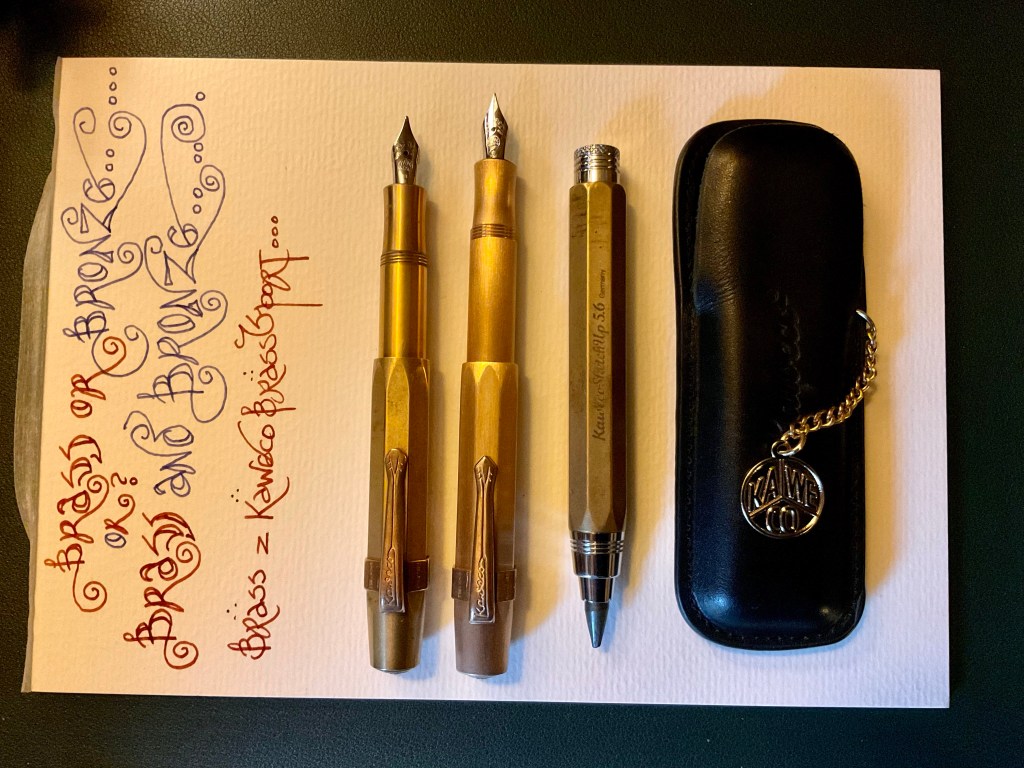
Because of the weight of a pencil, and the comfort of use, it has always been a gift to the drawing pictures experience in reality. So should equate with written words. Weight? So light. Well you can move about all day and carry a pencil behind your ear can’t you. My Kaweco Brass Sketch Up pencil is nowhere near a comfortable carry about though. Heavy with a clutch mechanism holding a hefty 5.6 mm lead and weighing in at 36 to 43 grams. A clutch mechanism is basically a ‘claw’ that opens up at the writing end by pushing a push-button on the cap end. Once the lead is housed by hand inside the barrel, the claw closes down on push-button release and holds the lead tightly. For the amount of pencil lead exposure, you hold the pencil and let gravity drop it to required need. Brass? Heavy for long writing or drawing use though. But what a beautiful looking mechanical pencil! Especially when the brass develops a unique patina from the hand’s natural oils and the eyes’ tears when using it to write down deep emotional sessions.
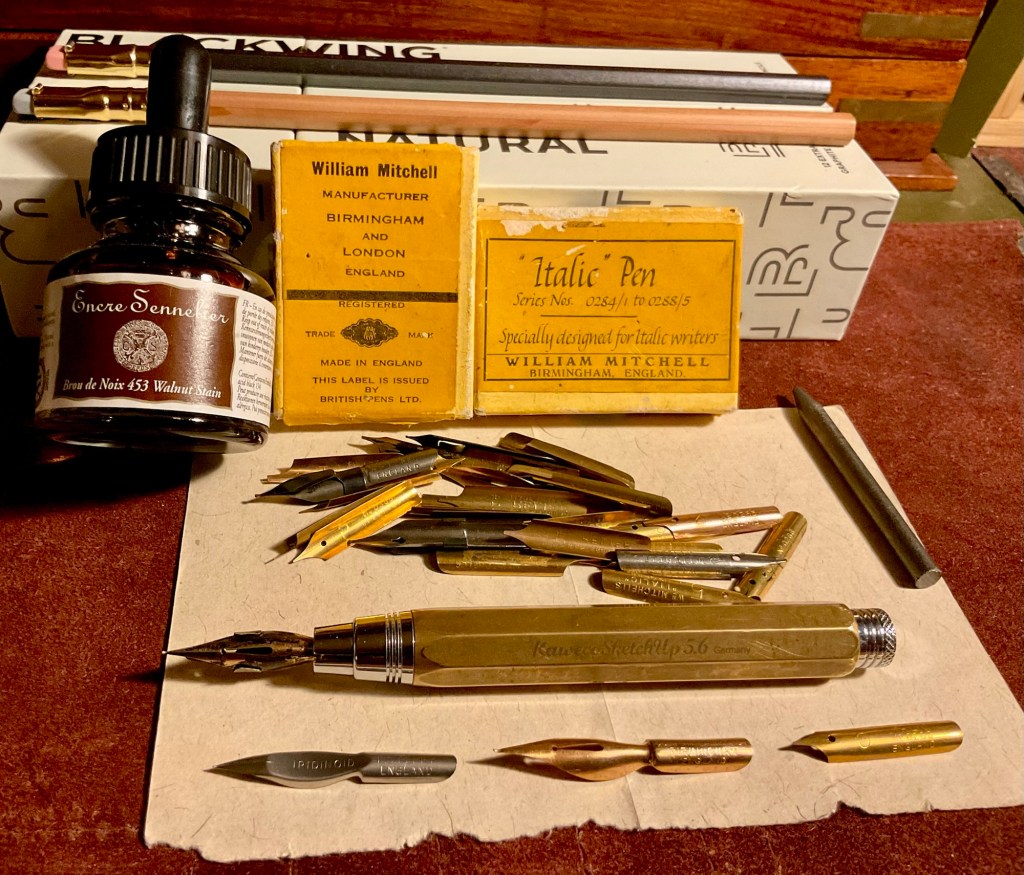
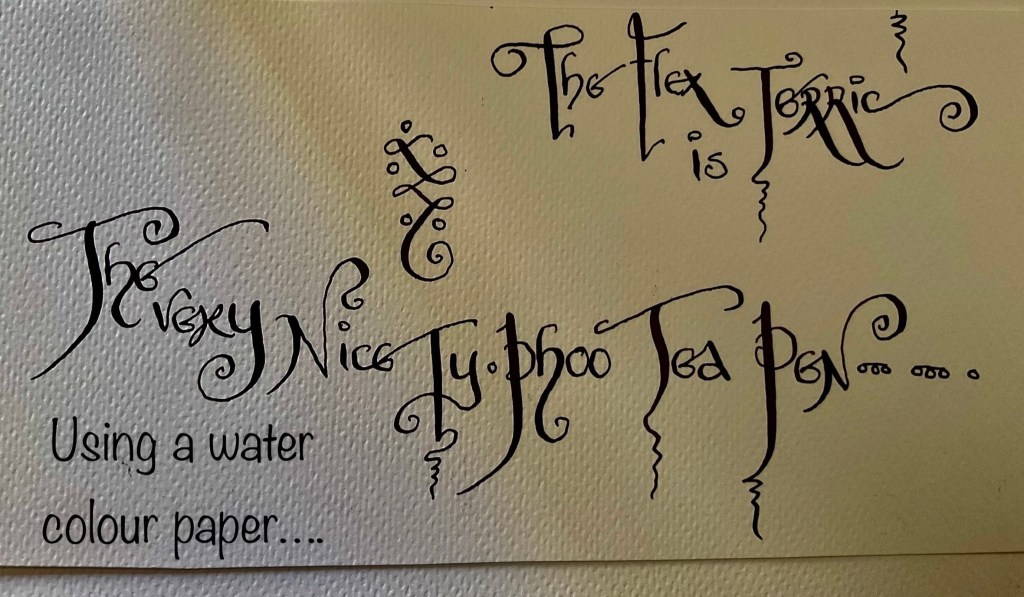
Yesterday, I read a comment on a YouTube Kaweco Sketch Up review that said dip nibs can be housed in the ‘claw’ too. I tried it out on a few of my vintage nib favourites, and yes indeed, they held securely. Wish I had known that a few years ago when I first obtained the pencil. So I can now use the Sketch Up as a dip nib ink writer too. Some of the dip nib designs I own were too narrow and didn’t sit properly. But three of my favourite makes, and most often used nibs…the Brandauer Clan Glengarry, the William Mitchell Italic Nib series and the Esterbrook 314 Relief nibs…all work a treat. Other little odd makes work too. But the longevity of writing individual letters is very short with some choices. It is a case of continually re dipping into the ink pot after writing one or two words. It gets tedious. So, now finding out that the Kaweco can double up as a new writing tool….I realise that it is always good to read the reply comments. A bit of useful informative extra thoughts and advice from others can always be found amongst the much appreciated ‘great read’ comments.
Rather like here on WordPress really.
 Gray Summers